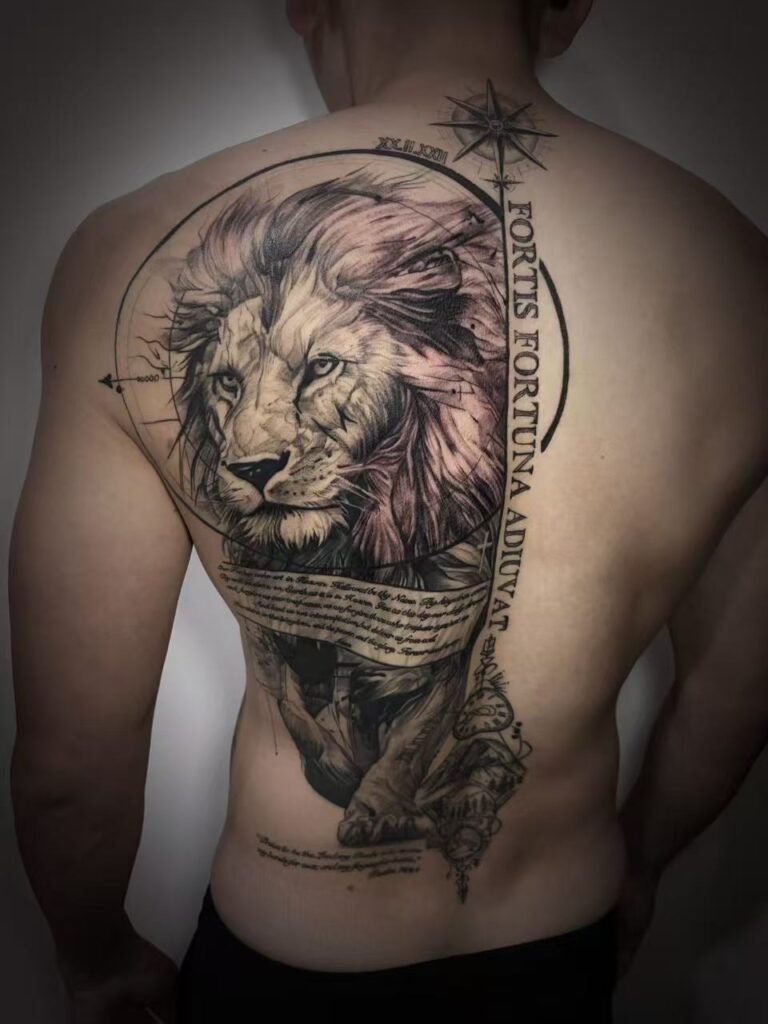
Lion tattoo meaning comes from context, not from a universal symbol list. People may connect a lion with courage, authority, family, vigilance or a private memory, but the tattoo communicates first through the animal’s gaze, posture, mane and relationship to the body. A calm profile and a frontal roar can use the same subject while creating completely different impressions.
Start by deciding whether you want a portrait, a full-body animal or a pair. Then choose where the lion looks, how much of the mane controls the silhouette and what the pose is doing. Those choices give an artist a usable composition; a long list of abstract meanings does not.
Separate personal meaning from visual direction
The lion has appeared in art across regions and periods, with roles that range from royal image to guardian, adversary and observed animal. That history is too broad to compress into one definition. A lion tattoo may feel protective to one wearer and commemorative to another. Neither reading can be inferred reliably from the motif alone.
Write your reason in one sentence for the artist, even if it will remain private. Next, translate it into an observable mood. “Watchful and contained” could suggest a closed mouth, level gaze and steady head. “Force in motion” might call for a walking body, turned shoulders and an active tail. This translation matters because viewers see posture before they know the story.
Natural history can help you draw a convincing animal without dictating what it must mean. The University of Michigan’s Animal Diversity Web account of the lion describes the mane as a visual signal between lions and notes that lions may stand or crouch while roaring. These are useful form and behaviour references. They do not turn every mane into a crown or every open mouth into the same human message.
Choose the composition before collecting details
Three basic formats cover most lion tattoo ideas. Each asks for a different kind of reference and amount of skin.
| Format | What leads the design | What it needs | Common planning risk |
|---|---|---|---|
| Head portrait | Eyes, muzzle, head angle and mane edge | A clear face reference and enough scale for value separation | Treating every strand of mane as equally important |
| Full-body lion | Spine, shoulders, paws, tail and line of travel | A pose reference showing the entire animal | Making the face large while compressing the body |
| Paired lions | Relationship between two silhouettes and gazes | Two compatible poses and a clear hierarchy | Duplicating two equal portraits with no interaction |
A portrait is not automatically more realistic or more meaningful than a full body. It simply spends more of the available area on expression. A full-body design can show restraint, speed or weight through the torso and limbs. A pair adds a relationship, but it also doubles the number of faces, outer edges and directions that must stay clear.
Gaze decides where the viewer enters
The eyes are usually the first point of attention in a lion portrait. A frontal gaze addresses the viewer directly and favours placements that can offer a reasonably stable front plane, such as the outer upper arm, thigh, chest or back. A three-quarter head shows more muzzle length and can turn around a shoulder or thigh without splitting the face evenly down the centre. A profile creates a long, directional shape suited to a forearm, calf or side panel.
Head direction should be checked in a photograph of the actual body area. “Facing inward” can become unclear on a limb because the answer changes when the arm rotates. State left or right side, identify the surface, and mark which way the nose should point when you stand naturally. The guide to describing tattoo placement explains how to photograph direction without relying on a mirrored selfie.
Historical sculpture offers a useful lesson in planned viewing angle. A fourth-century BCE lion from the Mausoleum at Halicarnassus in the British Museum collection turns its head and was carved to be seen from a particular side. A tattoo also has a preferred view. The difference is that a shoulder, arm or leg keeps moving, so the secondary view needs to remain coherent rather than looking accidentally cropped.
Let the mane build the outer shape
The mane is not background texture. In a head portrait, it is the main boundary between the lion and the surrounding skin. A broad circular mane can make a compact, emblem-like composition. A wind-swept mane produces a diagonal and can carry the eye into the shoulder, chest or upper arm. A cropped mane makes the face dominant but leaves less material for joining the portrait to flowers, landscape or another subject.
Plan the mane in masses before individual hairs. Identify two or three large dark groups, the lighter breaks between them and the edge that must stay readable from normal viewing distance. If every lock receives the same contrast, the face can disappear inside a ring of noise. If the mane is reduced to a smooth halo, the animal may lose weight and direction.
For a photographic approach, use a high-resolution image with clear eyes, muzzle planes and mane flow. The animal portrait reference-photo guide explains why one sharp primary image is more useful than a folder of incompatible faces. Supporting references may show mane texture or ear shape, but they should not change the identity or head angle halfway through the drawing.
Posture changes the emotional read
A full-body lion offers more verbs than a portrait. It can rest, stand, walk, turn, crouch or roar. Choose one action rather than asking the body to suggest several at once.
Resting or seated
A recumbent lion can feel settled, observant or monumental. Crossed paws and a level back create strong horizontal weight, which can suit a thigh, upper back or wider chest area. The British Museum’s paired Prudhoe lion uses a recumbent body, curled tail and stylised mane, showing how calm posture can still hold considerable presence.
Standing or walking
A standing lion emphasises balance and silhouette. A walking lion adds a clear line through the spine, shoulders and advancing paws. It works best where the body has room to travel, such as the outer thigh, side torso or a larger arm panel. Compressing the legs under an oversized head can make the pose feel decorative rather than believable.
Turning or roaring
A turned head introduces tension because the torso and gaze point in different directions. A roar adds teeth, tongue, jaw and wrinkles, all of which compete for space. An open mouth should therefore be chosen for the expression, not added as a generic sign of strength. At smaller scale, a controlled mouth and clear eye may read more strongly than a crowded set of teeth.
One lion and two lions are different design problems
A single lion can own the whole focal area. A pair needs a relationship. They may face each other, look in opposite directions, move together or use one larger figure with a quieter secondary one. Decide whether equality or hierarchy is the point.
Mirrored pairs can suit the chest, upper back or paired thighs, but the body itself is not perfectly flat or symmetrical. The drawing must account for different curves, posture and how the two sides are seen together. A parent-and-cub idea requires accurate size and behaviour references rather than simply shrinking the adult figure. Personal family meaning should be supplied by the client, not asserted by the image.
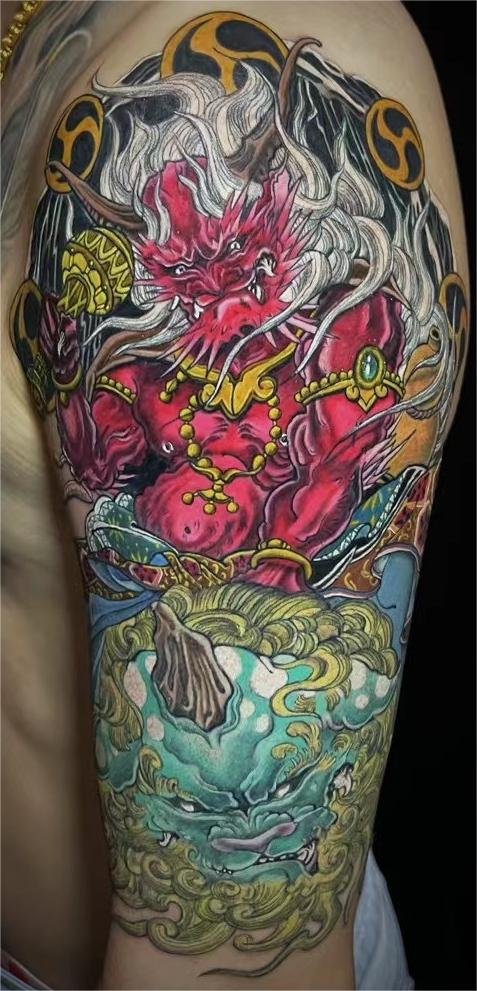
Keep this general lion concept separate from Asian guardian-lion imagery. A naturalistic African or Asiatic lion is not automatically a shishi, komainu or Chinese guardian lion. Those figures have their own visual traditions, objects and architectural roles. If your reference includes a ball, cub, pedestal or temple setting, identify the source before combining categories.
For comparison, the wolf tattoo planning guide focuses on a different animal silhouette, social image and movement vocabulary. Borrowing a wolf’s long muzzle or pack arrangement without checking lion anatomy can make a lion reference feel generic.
Match the lion format to the body area
| Placement | Lion format that often fits | Main question to resolve |
|---|---|---|
| Outer upper arm or shoulder | Three-quarter portrait or compact turning body | Does the face remain readable as the arm rotates? |
| Forearm | Profile head, vertical portrait or simplified walking form | Will the mane wrap away from the main view? |
| Chest | Frontal portrait, paired composition or broad recumbent form | How does the design relate to the sternum and collarbone? |
| Back | Large portrait, full animal, landscape or pair | Which face or action remains the first focal point? |
| Thigh | Portrait, seated lion or full walking body | Does the silhouette work from front and side views? |
| Calf | Vertical profile or compact full-body pose | Can the legs and face stay separate on the taper? |
Placement is not a promise that every desired detail will fit. Mane texture, eyes, whisker roots, paws and surrounding elements all draw from the same space. Review the proposed design at body-viewing distance, not only as a zoomed screen image. The tattoo readability guide gives a practical test for focal point, contrast and open skin.
Build a focused lion tattoo brief
Before contacting an artist, prepare:
- One sentence describing the personal context or mood.
- Portrait, full-body or paired format.
- Frontal, three-quarter or profile gaze.
- Calm, walking, turning, crouching or roaring posture.
- One primary lion reference with source or permission noted.
- Left or right body side, preferred surface and approximate boundaries.
- Colour or black-and-grey direction, plus any essential secondary element.
- Clear photographs of the placement in a relaxed position.
Avoid attaching a lion face from one photograph, a mane from a second, a body from a third and asking for all of them to be copied literally. Mark what you like about each image instead. That lets the artist build a coherent animal with one light direction and one anatomy.
When the pose and reference are ready, send them with your placement photographs through the Yuyi Tattoo contact page. Yuyi Tattoo’s documented portfolio includes black-and-grey realism, large-scale work and Asian-inspired compositions. Project suitability, design scope and availability are confirmed from the individual brief rather than assumed from the motif.
Sources and review date
- University of Michigan Animal Diversity Web: Panthera leo — reviewed 24 August 2026.
- British Museum: marble lion from the Mausoleum at Halicarnassus — reviewed 24 August 2026.
- British Museum: the Prudhoe Lions — reviewed 24 August 2026.
Frequently asked questions
What does a lion tattoo mean?
There is no single lion tattoo meaning shared by every culture or wearer. Courage, authority, family, protection and remembrance are common personal readings, but posture, gaze, surrounding imagery and the client’s own reason determine the specific context.
Is a lion portrait better than a full-body lion tattoo?
Neither format is inherently better. A portrait gives more space to eyes, muzzle and mane. A full-body lion gives more space to action, weight and direction. Choose according to the body area and what you want the animal to be doing.
Which way should a lion tattoo face?
The useful answer depends on the preferred view of the placement. Check direction on a photograph of your relaxed body, then state which way the nose should point. A profile needs length, while a frontal gaze needs a stable surface and enough width.
Can two lions represent family?
They can if that is the meaning you give them, but the image does not prove a family relationship by itself. Decide whether the lions are equals, a parent and cub, or simply a visual pair, then choose references that make that relationship clear.
How small can a detailed lion tattoo be?
There is no universal minimum measurement. The workable scale depends on style, face angle, mane density, placement and how much background is included. If the eyes, muzzle and mane cannot remain separate, simplify the design or allow more space.
What should I send for a lion tattoo enquiry in Singapore?
Send one main lion reference, the desired gaze and posture, placement photographs, approximate boundaries, colour direction and a note on any essential pairing. A focused brief makes composition review more useful than a generic request for a lion with meaning.