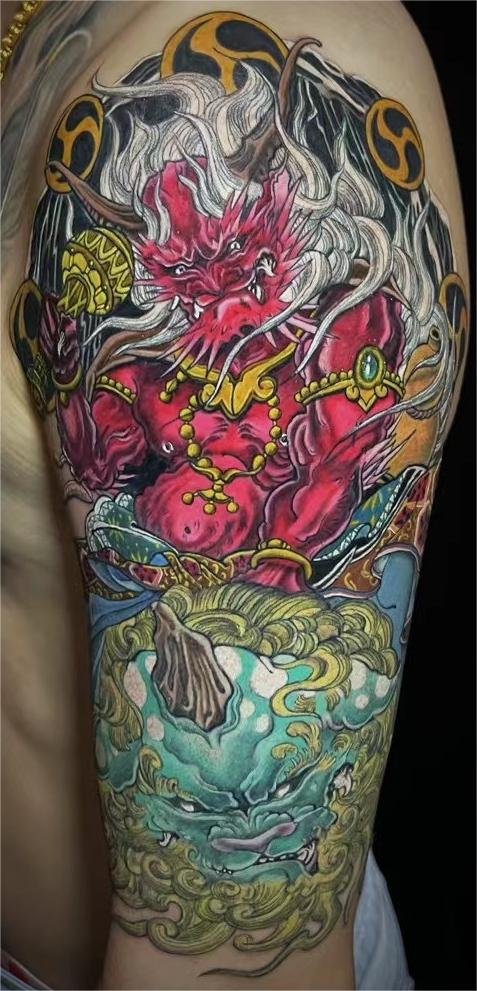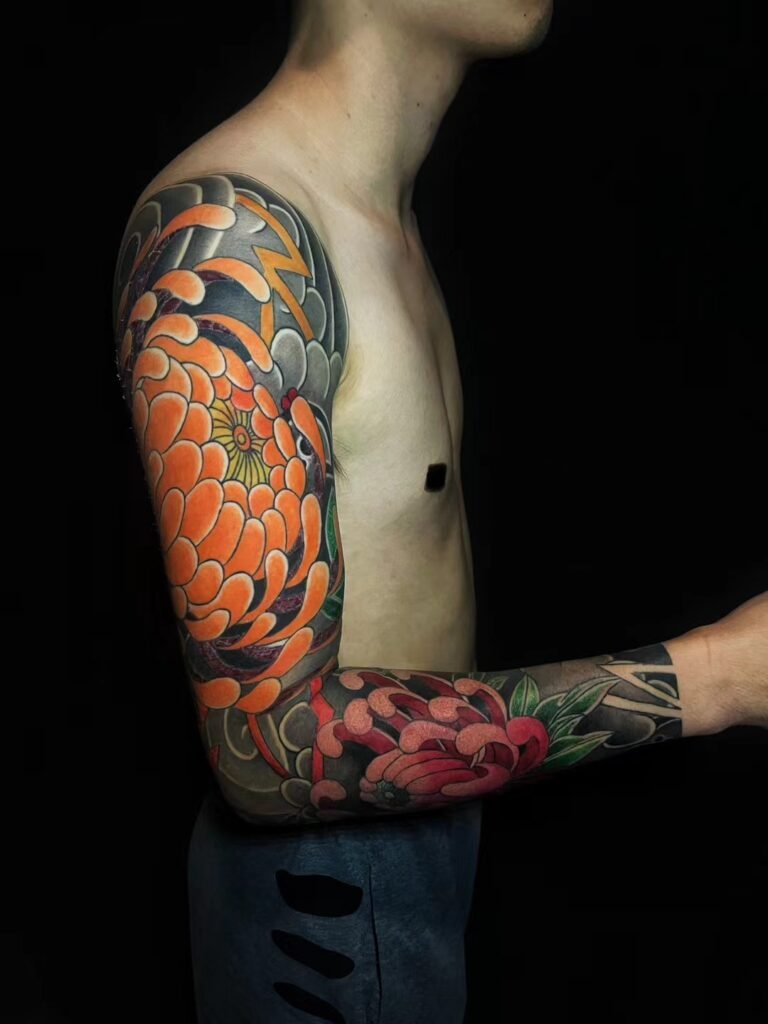
Separate tattoos can often be developed into a sleeve that looks intentional, but they do not always need to be physically joined. The artist first has to review the tattoos now on your arm, the open skin between them, their visual weight and the coverage you want. Some groups can share a background; others look better framed by controlled negative space or treated as a coordinated collection.
Send current whole-arm photos, close views of every existing tattoo, the area you want the project to cover and a clear style direction before consultation. Those images allow an artist to judge what can be integrated, what should remain distinct and whether a proposed connection would improve the arm. They do not guarantee that every piece can be joined, reworked or covered.
Start with the arm you have, not a blank-sleeve idea
A new sleeve can be planned around an empty arm. An extension project cannot. Every existing tattoo is a fixed visual fact with its own position, outline, direction, scale, colour and darkness. Even a piece you love may sit at an angle that complicates the whole-arm flow. A small tattoo can also have more influence than its size suggests if it occupies a key turn near the elbow, shoulder or wrist.
The first design task is therefore an inventory, not a search for filler. An artist needs to see:
- where each tattoo begins and ends;
- which direction its subject faces or moves;
- which piece attracts attention first;
- how much open skin separates the pieces;
- whether the old work is light, dark, soft, bold, colour or black-and-grey;
- which tattoos must remain unchanged and which you are willing to discuss.
This is the main difference from planning a full sleeve on a mostly open arm. That guide compares unified and collection-based routes from the planning stage. Here, the composition must begin with work that already exists.
Connected does not have to mean covered in filler
There are at least three honest ways to make separate tattoos belong on one arm. The right route depends on what the existing work gives the artist, not on a rule that every sleeve should look continuous.
| Route | What creates unity | What remains visible |
|---|---|---|
| Integrated composition | One background system, value pattern or directional movement crosses the arm | Existing tattoos become fixed subjects inside a larger design |
| Framed collection | Repeated spacing, borders, small supporting forms or controlled background panels | Each old tattoo keeps a clear edge and its own identity |
| Deliberately separate arrangement | Similar visual rhythm and purposeful gaps | Bare skin stays visible between independent pieces |
An integrated composition can work when the tattoos leave usable pathways and their scale or style can sit under one visual hierarchy. A framed collection may be better when the pieces have very different drawing languages. Deliberate separation is a valid finish when open skin already creates a calm rhythm.
The mistake is choosing a connector before deciding which of these outcomes you want. Smoke, waves, leaves, clouds, geometric fields and dark shading are not universal glue. A background element needs a structural job: carry the eye, separate competing edges, support a focal point or finish a boundary. If it only occupies an awkward gap, it may make the sleeve feel more forced rather than less.
Use negative space as part of the composition
Negative space is the area around and between subjects, but it is still a designed shape. On an arm, it can isolate an old tattoo, create a visual pause after a dark section and give a new element room to turn around the body. It can also prevent two unrelated outlines from appearing accidentally attached.
Look at the gaps as shapes of their own. A narrow strip that pinches between two tattoos may be too cramped for another detailed image. Leaving that strip open could make both pieces clearer. A wider gap might hold a quiet transition, while a clean band near a joint may be useful as a deliberate break. Filling all three spaces in the same way ignores what each one is doing.
General composition principles help explain why. Viewers tend to group nearby or visually similar forms, and they tend to follow smooth continuities. This means tattoos can feel related through spacing, repeated values and directional alignment without a literal line connecting them. It also means one dense patch of filler can create a new group that competes with the tattoos it was meant to support.
Build sleeve tattoo flow around fixed points
Sleeve tattoo flow is the path the eye follows around the arm. With existing tattoos, the artist cannot freely place every focal point, so the process becomes one of editing and redirection.
First, identify the visual anchor. This may be the largest tattoo, the darkest one or the subject placed on the arm’s most visible surface. It does not have to be your oldest or most meaningful piece. It simply needs to function as the strongest read in the final composition.
Next, trace possible paths from that anchor. A background curve, repeated shadow edge or sequence of smaller shapes can guide the eye toward another tattoo. The route should still make sense when the arm hangs naturally and when it turns. A connection that works only in one carefully posed photograph may break apart in everyday views.
Then compare value and scale. Two tattoos do not need the same subject, but a very dark block beside a pale, delicate piece creates an imbalance that a thin connector cannot solve. The new work may need to redistribute dark and light areas across a larger section. That decision must be made from current photos and an artist’s assessment, not from a generic sleeve template.
Finally, decide where the composition should stop. A sleeve needs intentional edges at the shoulder and wrist, or at the chosen boundaries of a partial sleeve. If you may later extend toward the chest, hand or back, say so before a closed edge is designed. The large-scale tattoo planning guide explains why the whole coverage map matters before individual details are added.
Match visual logic, not every subject
Trying to invent one story that explains unrelated old tattoos can make the design feel artificial. A portrait, a flower and a small symbol do not need a new narrative that claims they were always one scene. They need compatible visual roles.
Unity can come from several quieter decisions:
- repeat a limited range of line weight or edge softness in the new work;
- use one controlled black-and-grey value structure around mixed subjects;
- repeat a small shape at considered intervals rather than in every gap;
- keep one direction of movement through background or supporting forms;
- give each existing tattoo enough space to remain readable;
- let one piece lead while the others become secondary.
Colour requires the same restraint. Adding the same accent colour beside every old tattoo may create repetition, but it will not automatically balance different levels of saturation or contrast. An artist needs to see the actual colour in neutral light before proposing how new colour, black-and-grey work or open skin might relate to it.
Know when not to force a connection
Sometimes the strongest plan is to stop trying to make the old tattoos look like one original drawing. An artist may recommend a framed or separate arrangement when:
- the open gaps are too narrow or irregular to hold useful transitions;
- several dark tattoos already compete for attention and more background would remove needed breathing room;
- the pieces point in conflicting directions that cannot be redirected cleanly;
- their styles, edge qualities or levels of detail are too different for one background to resolve;
- a proposed connector would cross an area you want left open;
- keeping the tattoos distinct better reflects what you like about them.
A refusal to fill every gap is not a failed sleeve plan. It is a composition decision. Alternatives might include building one new panel beside the old work, framing only part of the arm, keeping a deliberate skin break or treating the arm as a collection with consistent spacing. Which alternatives are feasible remains project-specific.
Reworking or covering an old tattoo is also a separate decision from connecting the sleeve. New surrounding work cannot erase the ink underneath. If one existing piece is the main obstacle, the artist must review that tattoo directly and discuss what, if anything, can be considered. No article can promise that it can be altered, absorbed or hidden.
What to send before a large tattoo consultation
Good photos let the first conversation focus on composition rather than guesswork. Prepare this set:
- Four uncropped whole-arm photos: outer, inner, front and back views, with the arm relaxed.
- One closer, straight photograph of each existing tattoo, plus an angled view when the piece wraps.
- Neutral, even lighting without filters, portrait mode blur or heavy contrast editing.
- A written coverage boundary, such as shoulder to wrist, upper arm to below the elbow, or forearm only.
- A note identifying tattoos that must stay untouched and any you are open to discussing.
- Two to four references for the new direction, labelled by what each image shows: flow, background, contrast, colour or spacing.
- A simple preference: one integrated composition, a connected collection, deliberate separation, or unsure.
If the project may move beyond the arm, include wider photos showing the shoulder, chest or back boundary without sending more personal imagery than the discussion requires. You can use the tattoo enquiry guide to organise the subject, placement, references and coverage into one readable message.
Do not draw heavy digital filler over the only copy of your photos. Keep clean originals, then use duplicates if you want to circle areas or mark a possible boundary. The unmarked views let the artist assess the real spacing and edges.
Turn the first review into a clear decision
A useful consultation should answer a sequence of design questions. Which tattoo leads? Which pieces should remain visually independent? Where should open skin stay? What kind of transition has a real compositional purpose? Where does the proposed sleeve begin and end? Which parts cannot be assessed without seeing the arm directly?
Those answers should come before choosing small filler motifs. They also come before any claim about whether old work can be reworked or covered. Large projects are reviewed and planned case by case, so photos start the assessment but do not replace an artist’s inspection or create a booking.
When your images and coverage goal are ready, contact Yuyi Tattoo or send the photos by WhatsApp to discuss whether a connected, framed or deliberately open sleeve is worth exploring. The first step is an artist review of the arm as it exists now.
Sources and review date
- J. Paul Getty Museum — Understanding Formal Analysis — reviewed 24 August 2026.
- Whitney Museum of American Art — Positive and Negative Space — reviewed 24 August 2026.
- University of Minnesota Open Textbook — Gestalt Principles — reviewed 24 August 2026.
Frequently asked questions
Can any group of separate tattoos be connected into a sleeve?
No. Many groups can be coordinated, but the available space, darkness, direction, style and placement of the existing work may limit direct connection. Current whole-arm photos and close views are necessary before an artist can say whether integration, framing or deliberate separation is the stronger route.
Do all tattoos in the sleeve need the same style?
Not necessarily. Different styles can share an arm when scale, spacing, visual weight and new background are controlled. If their differences are too strong, keeping clear space or a frame around each tattoo may look more intentional than trying to disguise the contrast.
Is filler the easiest way to connect old tattoos?
Filler is only useful when it has a defined job. It might guide the eye, support an anchor or complete a boundary. Filling every opening with small motifs or dark texture can reduce clarity and create new competition, so the whole-arm composition should be decided first.
Can my existing tattoos stay untouched?
They may be able to remain untouched while new work is designed around them, but feasibility depends on their edges, spacing and the coverage goal. Mark every piece you want preserved in the consultation brief and ask the artist to treat it as a fixed point during review.
What photos should I send to extend a tattoo into a sleeve?
Send outer, inner, front and back whole-arm views with the arm relaxed, plus clear close photographs of each existing tattoo. Add the desired coverage boundary, style references and a note about which pieces must stay unchanged. Avoid filters and tight crops that hide the surrounding skin.